
Artificial intelligence is no longer science fiction. From apps that suggest the next song you’ll enjoy to systems that help doctors detect disease, AI has quietly become a part of daily life. Behind every smart tool lies an AI model, the mathematical engine that powers predictions, recommendations, and decisions. Understanding what an AI model is—and how it learns—can make this invisible technology much easier to grasp.
The Core Idea: AI Models as Tools for Prediction
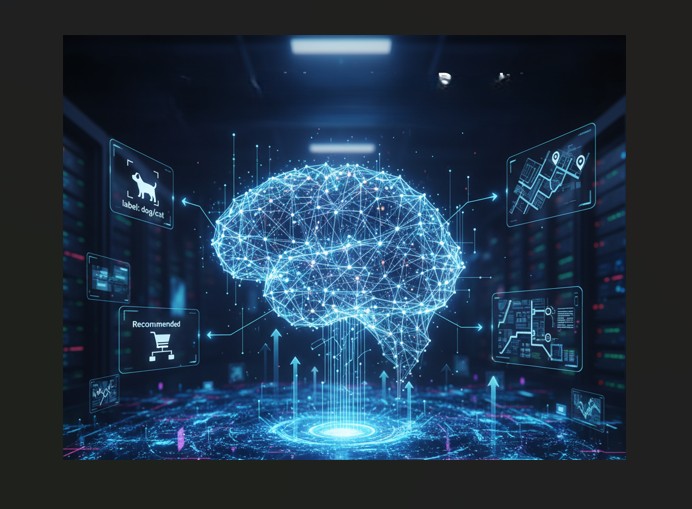
At its simplest, an AI model is a trained system that connects inputs to outputs. Think of it as a highly specialized tool: you feed it information, and it produces a result based on patterns it has learned.
For example:
- A photo goes in, a label (“dog” or “cat”) comes out
- A customer’s shopping history goes in, a product suggestion comes out
- A map’s traffic data goes in, a route recommendation comes out
AI models are not conscious or aware. They do not “understand” like humans. They excel at finding statistical patterns in data and applying them repeatedly, reliably, and often faster than any human could.
Models Are Born in Design, Then Trained
AI models are first created as frameworks—essentially empty structures ready to learn. Think of them as unshaped clay before the sculptor begins work.
The model itself starts without knowledge. During training, it is exposed to large amounts of relevant data. Each time it makes a prediction or classification, the model receives feedback: Was the answer correct, or how far off was it? Using this feedback, it adjusts its internal parameters slightly.
This process repeats millions, sometimes even billions of times. Gradually, the model improves, learning to make more accurate predictions.
Example: Predicting Health Risks
Consider a hospital using an AI model to predict which patients may develop certain conditions or illnesses, like diabetes. The model is trained on historical patient records, including factors like age, weight, blood sugar levels, and family history.
- Step 1: Training data is fed to the model.
- Step 2: The model makes predictions and compares them with actual outcomes.
- Step 3: It adjusts its internal parameters to improve accuracy.
After thousands of cycles, the model becomes reliable enough to help doctors flag at-risk patients earlier than traditional methods might allow. Importantly, the model does not understand health—it simply identifies patterns associated with higher risk.
Training Data: The Fuel for AI Models
Data is the lifeblood of AI models. The quality, diversity, and size of the dataset largely determine how well the model performs.
For instance, a model trained to recognize different types of animals will perform poorly if it is only given images of certain breeds or species. Similarly, a model for language translation will struggle if it hasn’t been exposed to enough examples of idioms, dialects, or slang.
This reliance on data explains why AI models sometimes fail in unexpected ways. If the data is biased or incomplete, the model’s predictions will be incorrect, reflecting those shortcomings.
Different Models for Different Jobs
Not all AI models are created equal. Depending on the task, different types of models are used:
- Classification models: Sort data into categories (e.g., spam vs. non-spam emails).
- Regression models: Predict continuous values (e.g., house prices based on location, size, and features).
- Recommendation models: Suggest items or content based on past behavior (e.g., Netflix or Spotify).
- Generative models: Produce new content that resembles training data (e.g., AI images, videos, or text).
Each type of model is structured differently and trained with specific methods, yet all share the same principle: learning from example data to predict outcomes.
The Lifecycle of an AI Model
Understanding how an AI model learns also involves looking at its full lifecycle:
- Design: Engineers decide the type of model and how it will handle data.
- Training: The model is fed data and gradually improves through repeated adjustment.
- Validation: The model is tested with new, unseen data to ensure it generalizes well.
- Deployment: The model is integrated into an application or service for users to employ..
- Monitoring & Updating: The model is continuously monitored to ensure it accurately adapts to new trends or behaviors.
This lifecycle highlights that AI models are tools maintained by humans, not autonomous entities.
Why AI Models Seem “Smart”
AI models can feel intelligent because they handle massive complexity and scale. They can analyze millions of data points in seconds, detect subtle patterns invisible to humans, and generate consistent predictions.
However, this “smartness” is performance, not understanding. The model does not reason, empathize, or explain its decisions in human terms. It simply identifies patterns and applies them.
Limitations to Keep in Mind
AI models have remarkable capabilities, but they are not infallible. Common limitations include:
- Bias: If training data reflects societal biases, the model’s predictions will too.
- Lack of Context: Models may misinterpret situations that exist outside the data they’ve seen.
- Overconfidence: A model may seem completely certain in the outputs it produces, even if they are incorrect.
This is why human oversight remains essential. AI models are powerful tools, but they work best when paired with human judgment.
Learning Without Understanding
A helpful way to think about AI models is as pattern detectors, not thinkers. A model for weather forecasting does not know what a storm is. It has simply observed the conditions that usually precede one, and identifies if those conditions are present again. A model that suggests movies does not understand the plots or storylines. It has learned which viewing habits tend to go together, and gives a recommendation accordingly.
Learning as an AI is therefore fundamentally different from human learning. AI models improve through repeated feedback and data exposure, not comprehension.
Why This Matters for Everyday Life
AI models are increasingly embedded in daily life. They influence:
- What videos appear on social media feeds
- Which products are recommended in online shopping
- How apps predict travel times or routes
- How companies detect fraud or cyber threats
Recognizing that these outputs come from models helps people interpret AI systems realistically. It also emphasizes the importance of data quality, transparency, and human oversight.
Conclusion: Models as Tools, Not Minds
An AI model is the engine behind intelligent systems. It is trained on data, refined through repeated feedback, and applied to real-world tasks. While it may produce outputs that seem intelligent, it does so without understanding, consciousness, or reasoning.
Understanding AI models allows people to appreciate both their power and their limits. It clarifies why AI can transform industries, yet also why mistakes, bias, and unexpected results are always possible.
In a world increasingly shaped by AI, knowing what a model is and how it learns is the first step toward making informed, responsible use of this transformative technology.