
Artificial intelligence has become a regular feature of modern headlines. It writes text, analyzes images, powers search engines, and influences decisions in various significant industries. Yet despite how often the term is used, it is frequently mixed together with two related ideas: machine learning and deep learning.
These three concepts are closely connected—but they are not the same. Understanding the difference helps clarify how modern technology actually works, and why some AI systems are more powerful, flexible, or limited than others.
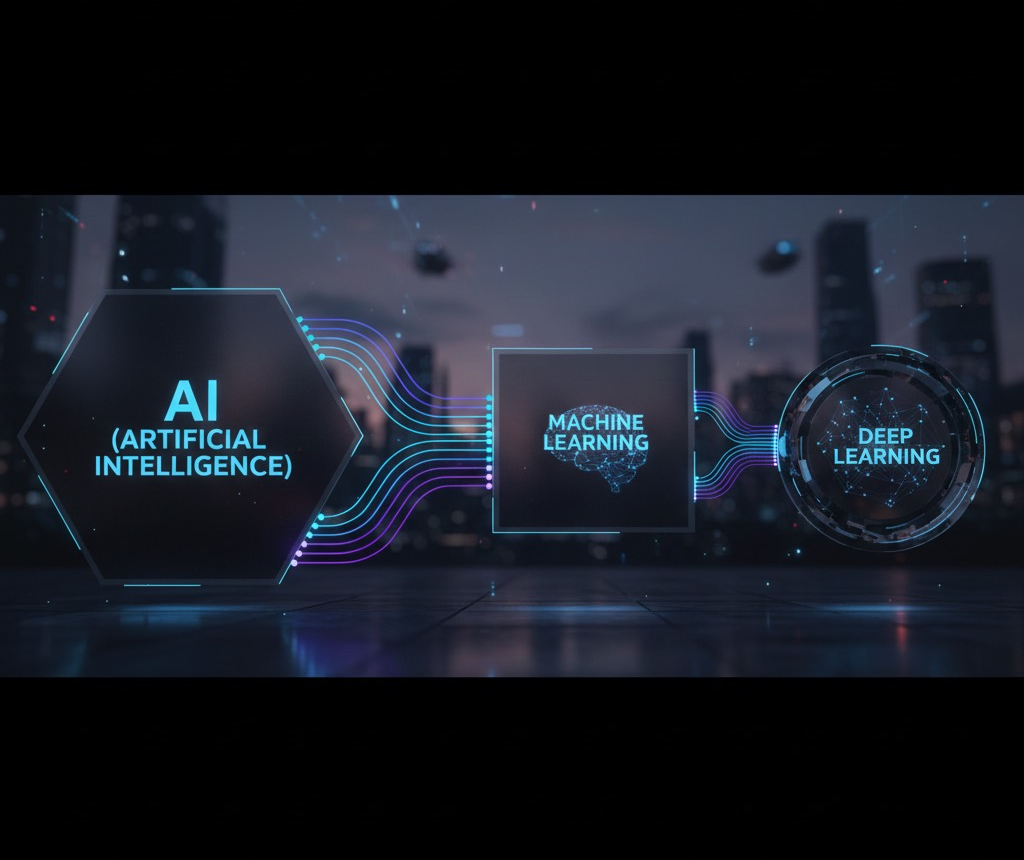
Rather than being entirely separate inventions, artificial intelligence, machine learning, and deep learning form a hierarchy of concepts that build upon each other. Together, they work in tandem to achieve advanced computational capabilities unlike any other individual processor.
Artificial Intelligence: The Big Picture
Artificial intelligence, or AI, is the broadest term of the three. It refers to the overall goal of creating machines that can perform tasks that normally require human intelligence.
This includes things like recognizing speech, identifying objects in images, understanding language, planning actions, or making decisions. AI describes what machines are meant to do, not necessarily how they do it.
Importantly, not all AI systems learn. Early AI programs relied on human-written rules. For example, a chess program could be built by encoding rules about legal moves and strategies. If the situation fell outside those rules, the system would fail.
These rule-based systems are still considered AI because they attempt to replicate intelligent behavior, even though they do not adapt or improve on their own.
In short, AI is the umbrella term that covers all approaches to making machines behave intelligently.
Machine Learning: Teaching AI to Learn
Machine learning is a subcategory of artificial intelligence. Instead of relying on hand-coded rules, machine learning allows systems to identify patterns from data.
Rather than telling a computer exactly how to identify spam emails, engineers show it millions of examples. The system analyzes those examples and figures out what characteristics tend to appear in spam versus legitimate messages.
Machine learning focuses on how AI systems improve through experience. The system adjusts itself as it processes more data, often becoming more accurate over time.
This approach is especially useful when:
- Rules are too complex to write manually
- Patterns change frequently
- Large volumes of data are available
Machine learning has become dominant because modern society produces enormous amounts of digital information, which rule-based AI can not effectively handle.
Not all AI uses machine learning, but most modern AI systems do.
Deep Learning: A Specialized Learning Method
Deep learning is a specific type of machine learning, not a separate category.
What distinguishes deep learning is its use of layered computational structures—often called deep neural networks—to process data in stages. Each layer extracts increasingly complex information from the input.
For example:
- Early layers might detect simple features like edges or shapes
- Middle layers combine those into patterns
- Later layers identify higher-level concepts
This layered approach allows deep learning systems to handle complex tasks such as image recognition, speech processing, and language translation with far greater accuracy than earlier methods.
The word “deep” simply refers to the number of layers involved—not to intelligence or understanding.
Deep learning systems usually require:
- Very large datasets
- Significant computing power
- Extensive training time
When these conditions are met, they often outperform other machine learning techniques.
How the Three Fit Together
A helpful way to understand the relationship between artificial intelligence, machine learning, and deep learning is to think about transportation.
Artificial intelligence is like the entire idea of transportation itself, with the goal of helping people move from one place to another. This includes many different methods, from walking paths to complex machines like trains and airplanes.
Machine learning is like motorized vehicles. Instead of relying on fixed paths, these systems can adjust how they operate based on experience, learning from past trips to improve efficiency.
Deep learning is like self-driving cars. It is a more advanced approach that uses many layers of decision-making to handle complex tasks, such as recognizing traffic signs or navigating busy streets.
Every self-driving car is a motorized vehicle, and every motorized vehicle is part of transportation. But not all transportation uses vehicles, and not all vehicles are self-driving.
In the same way:
- All deep learning is machine learning
- All machine learning is artificial intelligence
- But not all AI relies on machine learning, and not all machine learning relies on deep learning
This distinction matters because different problems require different tools. Some tasks can be solved with simple AI systems, while others require the advanced capabilities of machine learning or deep learning.
Why the Terms Are Often Confused
In news coverage and marketing, these terms are often used interchangeably. This happens for a few reasons.
First, modern AI breakthroughs are largely driven by both machine learning and deep learning, so the boundaries blur in practice.
Second, “AI” is more familiar and dramatic than technical terms. Companies often label their products as AI-powered even when they rely on relatively simple machine learning techniques.
Finally, from a user’s perspective, the internal method often doesn’t matter. What matters is what the system can do.
However, for understanding capabilities and limitations, the distinction is important.
Differences in Flexibility and Capability
AI systems built with fixed rules behave predictably but are limited. They perform well in controlled environments but struggle when conditions change.
Machine learning systems are more flexible. They adapt to patterns in data and can handle variability better. However, they depend heavily on the quality of their training data.
Deep learning systems excel at handling unstructured information such as images, audio, and natural language. They can find subtle patterns that simpler models miss. Yet, such processing potential comes at a cost, being substantially more resource-intensive and difficult to interpret.
In other words:
- Rule-based AI is precise but rigid
- Machine learning is adaptive but data-dependent
- Deep learning is powerful but complex
No single approach is best for every task.
Understanding Limitations Through Definitions
Knowing the difference between these terms also helps explain why AI sometimes fails.
When a system makes a mistake, it is often not “thinking incorrectly.” Instead, it is applying patterns learned from past data to a situation that differs from what it has seen before.
Deep learning systems, in particular, can produce highly confident outputs even when they are wrong. This is not a sign of intelligence—it is a consequence of statistical prediction.
Understanding which method is being used helps set realistic expectations for the accuracy of results.
Why the Distinction Matters for the Future
As AI becomes more embedded in society, conversations about trust, regulation, and responsibility are becoming more common.
A rule-based system may be easier to audit. A machine learning system may require ongoing monitoring. A deep learning system may be powerful but difficult to fully explain.
These differences influence:
- Transparency
- Accountability
- Safety
- Appropriate use
Lumping everything together as “AI” can obscure important details about how systems behave and where risks may arise.
A Clearer Way to Talk About AI
Artificial intelligence is not a single machine or invention. It is a collection of methods, goals, and tools that continue to evolve.
AI defines the destination.
Machine learning defines how systems learn along the way.
Deep learning defines one particularly effective route.
Understanding these differences does not require technical expertise—only clarity about what each term represents.
As AI continues to shape modern life, knowing how its pieces fit together helps transform confusion into informed awareness.